

As the early action deadline gets closer, anxiety rises in her. Trying to work on applications while balancing course work from advanced classes like AP literature and composition, AP Physics C, and Multi-variable Calculus, senior Riley Soffera has to put off assignments in order to get her applications done.
She calls over her mom, finally ready to submit her application two days before the looming deadline. She double checks, triple checks, quadruple checks the information to make sure her applications are perfect before she clicks the final submit button, and is congratulated by the Common App confetti signifying her application is done.
Seniors across the Bowie campus, and the nation as a whole all face a similar task when they choose to apply for college.
“I should have started earlier, most people should start applying to college in the summer of their junior year,” Soffera said. “A lot of seniors applying to college are taking AP classes and advanced classes, and it’s stressful applying to college on top of class starting.”
CONSIDERING COLLEGE
For many students in America, high school is not the end of their educational journey. According to the Education Data Initiative, 62 percent of high school graduates go on to post-secondary study, and in the fall of 2024 in the United States undergraduate college enrollment totaled 19.28 million students.
“College is a bubble where people are able to make mistakes, and take courses that they may not have taken in high school,” College and Career Advisor Amber Luna said. “It’s the one time where you can really try anything out and it does not really affect you in a way. Everybody is on the same playing field, they’re all trying to get a bachelor’s, better themselves, have different experiences, meet people, and find connections.”
According to the Harvard Division of Continuing Education (DCE) there are many things students can do while in high school to prepare themselves for college including creating an academic plan, developing good study habits and life skills, and participating in extracurricular activities.
“In my application I wanted to highlight my GPA, rank, and all the organizations that I am involved in like student council, ultimate Frisbee, and National Honor Society,” senior Reed Watts said. “Sometimes people are more concerned about their grades and how they’re going to get into whatever college they want to get into than actually learning the material and preparing themselves.”
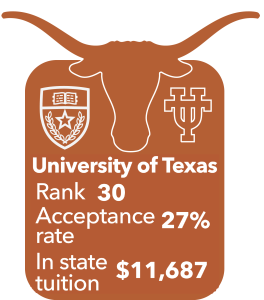
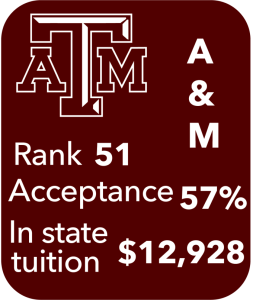
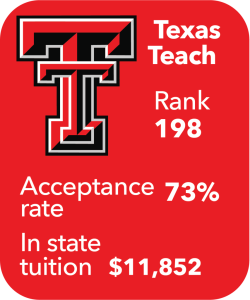
Colleges across the nation advertise what they are looking for in students, and offer statistics about the average students on their campus such as their average SAT scores. This information can be helpful to students trying to build a resume to get into their chosen universities, but can also cause stress for students who feel they don’t match the campus statistics. According to Big Future, the University of Texas(UT) at Austin has a 27% acceptance rate, an SAT score range of 1230–1480, and an ACT score range of 29–34.
“One of my parents went to college and she got into the UT School of Social Work,” Soffera said. “It’s a lot more difficult to get into college nowadays, because of the increasing number of people going to college. It’s become more competitive, especially in STEM fields. As a person going into engineering, it’s a very competitive field, schools only take a certain amount of mechanical engineers.”
College is not the only option for graduating students. Students can also move straight into joining the workforce, enroll in a trade school, take a gap year or a few, or join the military.
“If you want to go to college, you should go to college,” Watts said. “If someone is going to do something that needs a college education, they should go to college. However, it can be just as beneficial to go to trade school or to start working, we need all kinds of jobs.”
APPLYING AND ADVISING
When applying to college, the first step for many students is choosing which colleges to apply to and doing some research to see if
the college is a fit for them. There are multiple factors that influence students’ college decisions including college ranking, courses offered, campus life, location, and academic rigor.
“The academic program someone wants to go into is extremely important, but people should also look at the college campus, the dorms, the club life, and the social life,” Soffera said. “In college people are going to want to do things other than academics, and they’ll want to be in a community that best fits them. I’m an engineer, and I’m also in orchestra, so I’m looking at colleges that have an orchestra, because that’s something that I really care about.”
Another major influence to college application choices for students is whether or not a college is likely to accept them. College prep websites like Big Future can take students’ college lists and organize them into match, reach, and safety schools using information given to the site like GPA and test scores. This can help students create a balanced college list with realistic expectations about college acceptance.
“Some schools are really intense, and that in turn, makes students freak out,” Luna said. “I’ve had conversations with students and they’re like ‘I really want to get into UT, but it’s so hard to get in.’ They’re like, ‘I’m not good enough,’ and I have to tell them, ‘you are good enough.’ I want to continue to reiterate that to students. I do know the reality of college acceptances. There will be students that get denied, but that doesn’t mean that they can’t get into a college, it just means that they have to pivot. That’s one of the big things seniors applying to college are learning, is learning how to pivot.”
Even before students are sure about which colleges they want to apply to, they can begin their base college application. This is often done online through sites like Common App or Apply Texas, and requires students to fill out personal information about themselves as well as their family, education, activities, and honors. Once a student chooses the colleges they would like to apply to they can fill out the college specific applications through the same online sites. The college specific applications are often more thorough than the general application and allow or require students to submit supplemental essays.
“From what I’ve experienced at Bowie, Common App is more user friendly, so students are able to move through the application a little bit quicker,” Luna said. “ Apply Texas has free application week, which is amazing, and I think that that really stirs up kids to use that application. I don’t think students were using that application a lot, but now they have changed the interface, and it looks a lot easier for students.”
Students can create a Common App account at any time, but the Common Apps open for application submission on August 1 of every year. Following this, students have until their chosen school deadline to submit their applications. Colleges offer many different types of application submission cycles including, early action, early decision, regular decision, and rolling admission. Schools like A&M and Texas State offer rolling admissions meaning applicant materials are reviewed when they are submitted and a decision is made soon after. In comparison, some schools like UT offer different deadlines for students to submit their applications with corresponding decision dates.
“If I had a student, and she was wondering if she should apply early decision I would say if that’s her top school, do it, but that means if she is accepted, that is the only school she’s going to, she forfeits any other acceptances,” Luna said. “Let’s say she applied to UT, and UT gave her this great scholarship. If she said, ‘Miss Luna, I really want to go to UT’ I would then have to tell her, she can’t go to UT because she applied early decision somewhere else, it is a binding contract, she has to go to that school.”
Once a student applies to college through their chosen application platform they will often also have to create an account to a college portal for the school they applied to. In that portal the student can submit additional supplemental materials such as transcripts, letters of recommendation, test scores, and resumes. The portal is also often where colleges will show application and admission status.
“Colleges will see students’ extracurriculars, and transcripts, but the essay helps a lot give more context to who a student is,” Luna said. “When I worked at Texas Tech and I was reading applications, one of my favorite things to do was read the essay, because I can see the grades, and the test scores, but that doesn’t give me a feel for who the student is. If there is an option to send an essay, send the essay, you want colleges to know more about you.”
Applications require a lot of steps and can be stressful or overwhelming for students which is why schools offer resources like college counselors. Aside from helping students with individual questions, Luna often hosts college information sessions and visits from admission counselors to help students with their college applications. Outside of school, students can also access a variety of internet resources which can provide recommended timelines for working or breakdowns of application questions. In addition to this, students can hire their own personal college advisors to help with their applications.
“The college application process was good for me, I wrote my essays, did all the common app stuff, it was pretty straightforward,” Watts said. “Sometimes there were questions on the applications that I was just like ‘I don’t know.’ I had a college counselor, and she knew a lot of the answers. It’s not cheap, but it’s definitely helpful.”
CALCULATING COST
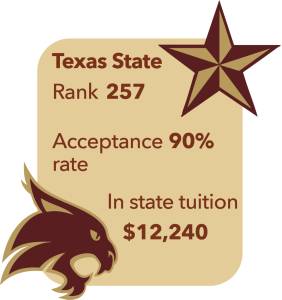
College can be a very expensive experience for a lot of Americans, but what students may not realize is that the application process can be costly as well. Texas State, UT, Texas Tech, and A&M all have a $75 application fee. In addition to this, there are fees required for students who are required to, or choose to submit SAT or ACT scores. On the College Board website, to send a school SAT scores there is a $15 fee. Both the application fee, and test score send fee can be waived if a student applies and qualifies for a fee waiver.
“I always like to be transparent and tell students to talk to their parents about how many schools they’re applying to, because it does cost a lot to send applications, and to send scores,” Luna said. “I do have fee waivers for a lot of these things, but they’re for students who are on free and reduced lunch or things like that. There is help to alleviate application fees, applying to college is expensive. When I was in high school, I only applied to four or five schools. I had to really do my research and decide where I really wanted to apply.”
According to the Education Data Initiative, tuition at four-year public universities has increased in cost by 36.7% from 2010 to 2023. Tuition cost has risen 197.4% since 1963, making the current college tuition 40 times more than it was then. Tuition prices can fluctuate based on many factors including whether an institution is private or public, or if a student is applying from in-state or out of state, but across the board tuition prices have risen.
“I have kids who are worried because college is so expensive, and they don’t know if that is something they, or their family can do financially,” Luna said. “I always say ‘if that’s where you’re at, what you can still apply.’ Students can get scholarships, or financial aid. There’s also community college, which is free at ACC right now.”

In order to better handle the cost of college students can fill out a Free Application for Federal Student Aid (FAFSA) to see if they are eligible for grants, scholarships, work-study programs, or loans. According to usa.gov, students must complete the FAFSA to be considered for federal student aid, and many states and colleges use the FAFSA information to award their own financial aid.
“Around October, when it opens, students would want to start working on the FAFSA,” Luna said. “It doesn’t take that long, students fill it out with their parents. Out of the population here at Bowie, some kids don’t really like to complete it. I always say students should just fill it out, because a lot of times schools will look at the FAFSA to give scholarships, even if students don’t get a grant, or a loan.”
There are many types of financial aid available for students including grants, work-study, loans, and scholarships. According to Luna, a spreadsheet of scholarship opportunities collected by AISD should become available to students at the end of November. In addition to this, students can find scholarship opportunities offered by the universities they are applying to, or on online sites like Big Future or Appily.
“Most people only rely on the FAFSA for financial aid when they should be looking into other scholarship opportunities,” Soffera said. “There’s so many scholarships that just give away money for people, like dependents of the military, women going into engineering, and minority groups. People should be looking into that as well as the FAFSA if they’re concerned about the cost of college.”