Skip to Content
Categories:

Bulldog nation, a lasting lecacy

The nearly ten-year impact of now retired principal Mark Robinson
Bulldog nation, a lasting lecacy
“Good Morning Bulldog Nation!” rang out in an enthusiastic voice across campus, as teachers and students looked up from their desks to hear the voice of new principal, Mark Robinson. On the first day of the 2017-2018 school year, Robinson introduced himself to the campus on speakers throughout the school, something no Bowie principal had ever done.

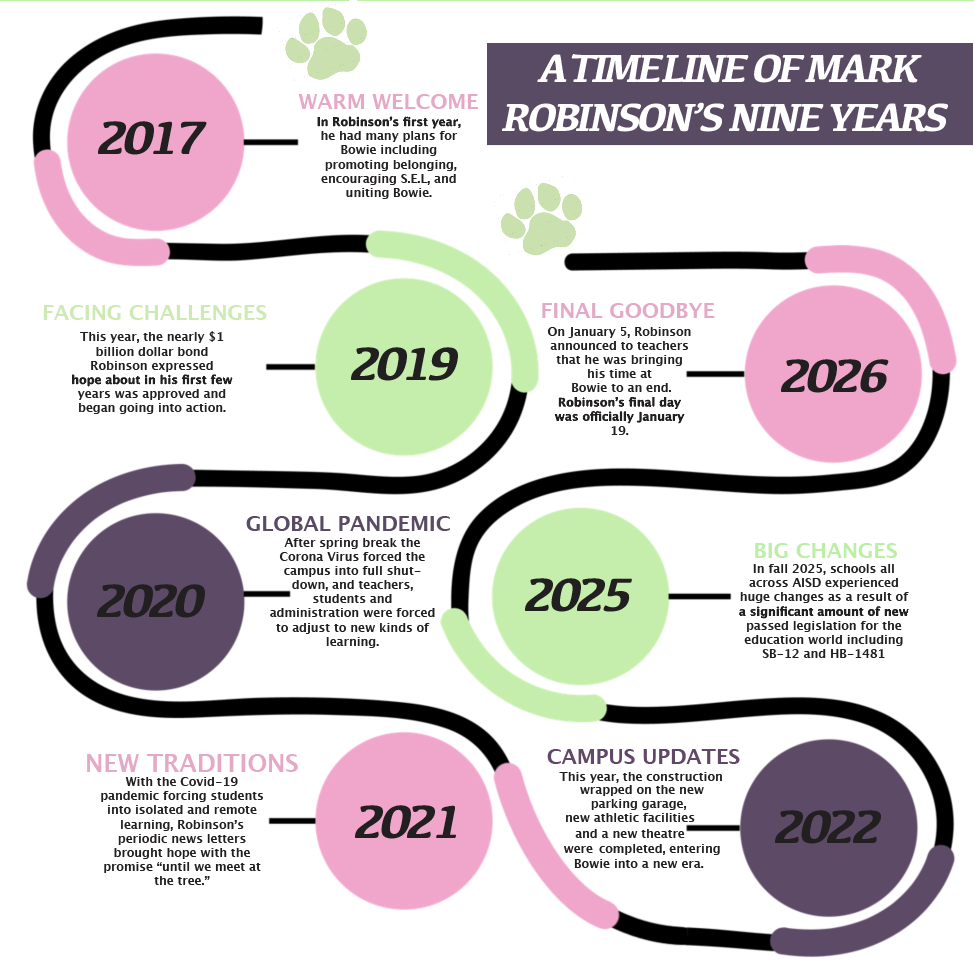
On Jan. 19, Robinson served his last official day as principal at Bowie, but his legacy and impact on the campus will stay for years to come. Robinson was Bowie’s third principal in 30 years, leading the campus through a global pandemic, new construction, and an effort to unite the campus.

“I’ve been with him since 2021,”Administrative Assistant, Joanna Willard said. “There are a lot of things that with public education that are tough and he would take on those challenges and work hard for our school and I will miss that really hardworking integrity he had, always trying to get what was best for all our staff and students.”
2017-2019

Robinson has worked in education for three decades, and before Bowie he worked several administrative and educative jobs at a multitude of schools, including working as an 8th grade history teacher at an alternative disciplinary school in Arlington AISD. His experience working at the disciplinary school is what shaped a good portion of his plans coming into Bowie.

“I worked with kids dealing with just incredible situations, incredible challenges, and kids who were in really bad situations,” Robinson said. “One thing I’ve learned in my 30 years of education is that there are no bad kids, there’s no bad people. There’s people who have had bad role modeling, people who are in bad situations, people who have been dealt a bad hand, and the only way that you can get out of those situations is through empowering yourself with education and taking advantage of the opportunities that we have in order to improve your situation. And so being able to get really good at that, I became the team leader and that’s where the idea that I could reach even more students, I could make a bigger impact and affect a bigger change started.”

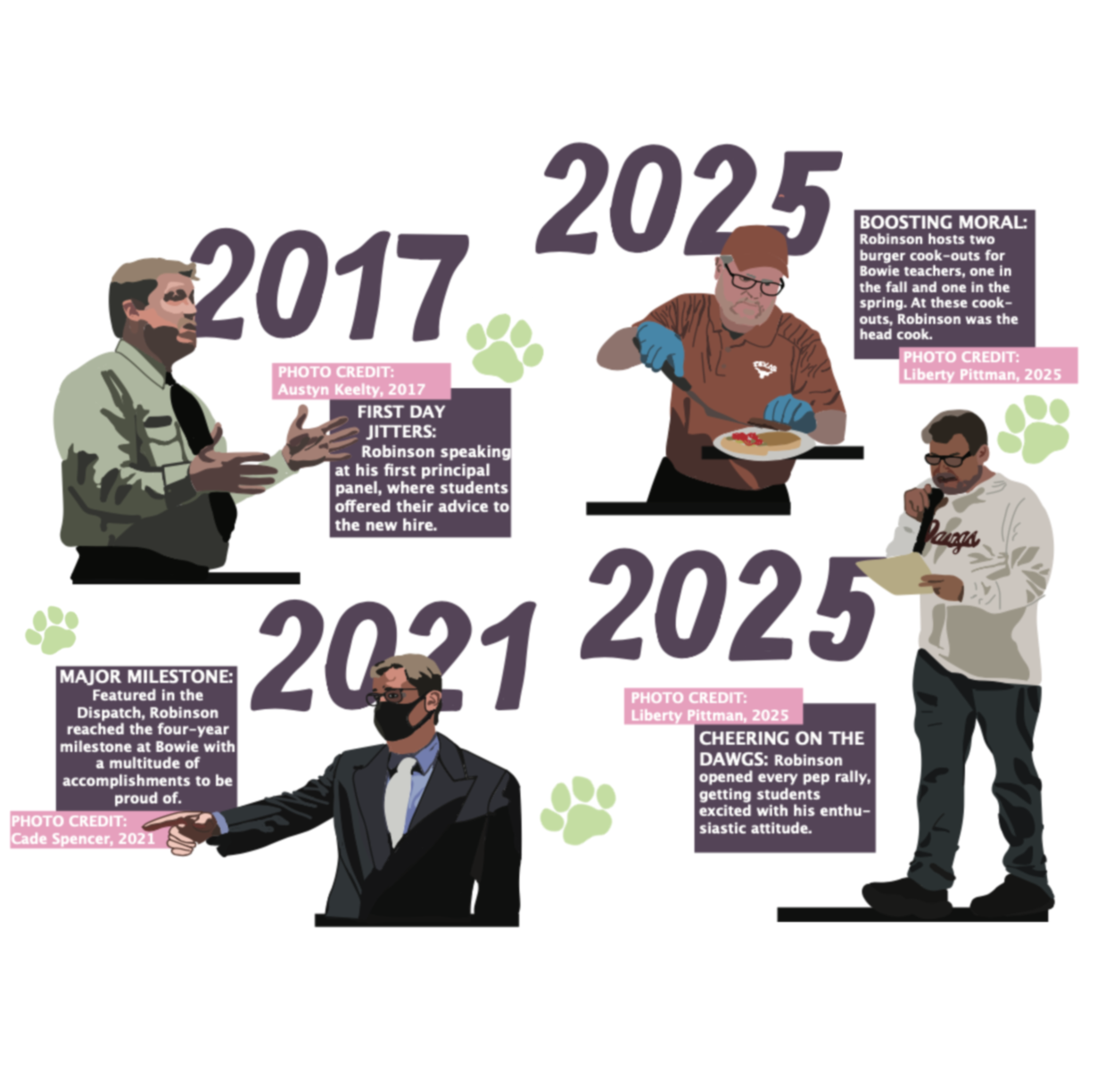
When coming to Bowie, Robinson hoped to unite the student body and connect kids across all different types of backgrounds and interests, bridging gaps between students with varying course levels. In a Bowie Dispatch feature published in 2017, Robinson shared that his biggest goal was to make certain every student felt like they had a place at Bowie.

“Principal Robinson would always treat everyone as equal and was very chatty, making people just feel like they were in the right place with him,” junior member of the principal panel Clover Murray said. “I think he impacted campus by always being around and available. I would often see him walking around the halls or the courtyard, checking in on teachers and students.”

Robinson came into the role of principal with a clear plan of action, and a few goals he wanted to accomplish fairly early on. These goals included an increased emphasis on social and emotional lessons, a push for the $1 billion AISD bond, and the introduction of new classroom tools, such as Chromebooks and Enriching Students.

“That’s kind of where ‘you belong at Bowie’ really started because we’d gotten really good at the science of education, but we needed to shift to the individualization, customization, personalization of learning so that we could really eliminate those achievement gaps,” Robinson said 

The principal’s panel is one example of a tradition Robinson started to help better unite the staff and students. In these panels, Robinson would meet with members to conduct general surveys about campus happenings and receive advice.

“The principal panel was a group of students recommended by their social studies teachers who met with Mark Robinson on a monthly basis in order to discuss student opinions on new policies, events or rules,” Murray said. “For example, we discussed the implementation of things like ‘Character Strong’ and digital hall passes with Robinson and we got to know that he really cared about how these policies affect students’ lives.”

Many student’s and staff’s first impression of Robinson was those first morning announcements, where he opened with Bulldog Nation and closed with “and always remember that you belong at Bowie.” He would continue to close all his announcements this way.

“There’s so many different groups that didn’t exist prior to COVID, that his emphasis of ‘you belong at Bowie’ brought about, there truly is something for everybody,” 2026 teacher of the year Alejandro Garcia said. “As long as you want to take that sometimes scary step forward to say, ‘I want to try to do that. I’m going to try to join something,’ which takes something inside to want to actually say that. But he always emphasized that and I think it has served us well.”

Both Bulldog Nation and ‘you belong at Bowie’ were a key part of Robinson’s mission to embrace diversity and unite Bowie, under the idea of all being a part of one ‘Nation.’ These ideas became a big part of how Bowie knew Robinson, and would be the catalyst for a lot of change as the year went on.

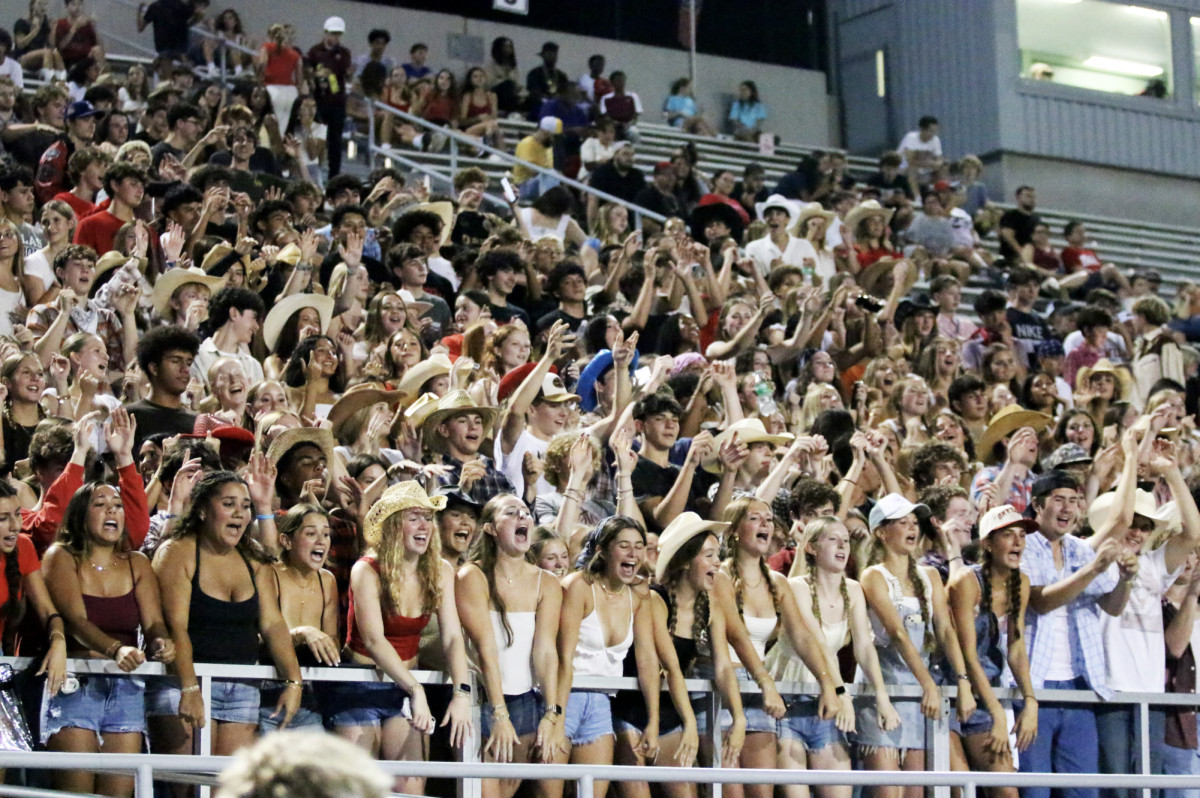
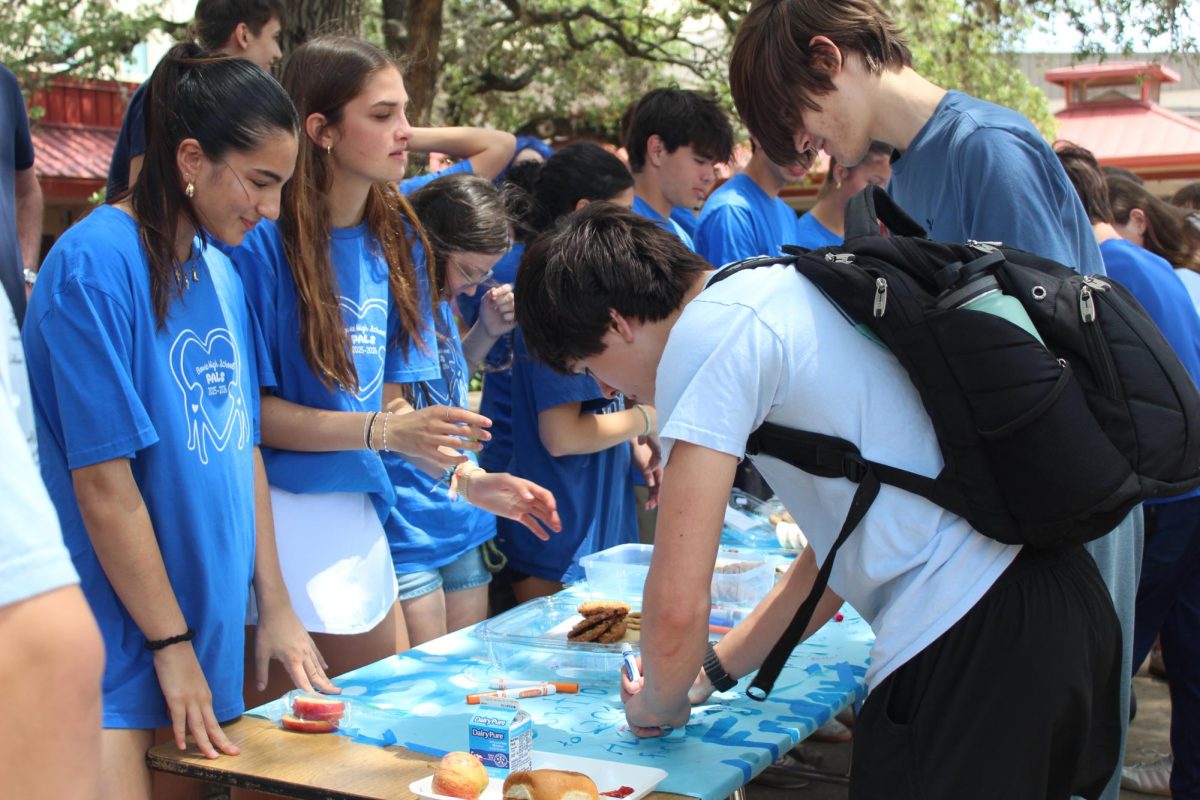
“‘The Bulldog Nation’ phrase is what he coined and said, all right, we’re all kind of aiming at one goal here, which you see everywhere, T-shirts and the gym and all the different things,” Garcia said. “He really emphasized the different programs, whether it’s student council or PALS or yearbook or newspaper and making sure that we have the necessary resources to be successful in those programs. ”

2020-2022

In the center of Robinson’s tenure at Bowie was one of the most uncertain time periods in the education world; a global pandemic. The Covid-19 virus forced Bowie students into remote learning in much of 2020 and 2021, and had lasting social and learning impacts on the school for many years to follow.

“When it went from everybody coming here on campus to us being in everybody’s living rooms or homes or spaces, it was just a huge shift,” Robinson said. “A lot of the thinking was about the logistics of how do we do this? What are we allowed to do? What do we need to do? And it was liberating in a big way, but also terrifying because we’d never done it before.”

The pandemic not only created change in the physical aspects and daily routines that Robinson had established in the four years he had already been at Bowie, but it also presented challenges for Robinson’s hope to bridge the academic and social gaps between students at Bowie.

“The other thing that I figured out really quickly was that there were certain things that were kind of essential to being effective,” Robinson said. “One of them was the courage to engage because it took courage to lead at that time when everything was so uncertain. We’d never done it before, just engaging was courageous. Then there was a need for connection, there was definitely a need for empathy, and those two things went hand in hand because everybody was in a different place. We needed to respect that we needed to meet people where they are, but then also maintain that connection because that was vital to everybody maintaining their sanity through that time of isolation.”

While students continued to be secluded to their homes unprepared for a school year turned ‘remote’ Robinson began sending out the ‘Bowie Star Newsletter,’ detailing official updates to students and parents. These newsletters were a staple of clear communication during a time of continuous mixed messaging.

“Clarity was really the fourth and probably the most important component in addition to courage, connection, empathy, clarity and communication because there was so much uncertainty at that time,” Robinson said. “It meant a lot to me that people saw that source of information as something that they could count on, something that they knew when they saw it in the newsletter that it was official.”

Robinson had a plan to combat the separation of students from campus, and it involved a beloved part of Bowie’s campus, the courtyard tree. In Robinson’s newsletters he coined the phrase “until we meet at the tree,” promising that one day Bowie would again be united, on campus and together.

“All of a sudden school is like where we all wanted to be,” Garcia said. “That’s because of him really pushing that mantra of ‘meet at the tree,’ that was the goal, that was the aim. His leadership style was that we wanted to rebuild our school to how great it was beforehand, and we’re going to take all these different steps to actually make that happen. And now looking in hindsight, six years after COVID, he did a fantastic job of doing that.”

The empty campus presented the opportunity to move ahead with the construction project included in the $1 billion AISD bond Robinson was pushing for approval in 2017.

“When I got to Bowie, the facilities were identified as one of the most challenging things about the campus,” Robinson said. “There were some things that had begun to wear out and deteriorate and things that really needed repair. In addition, our programs and our participation in our programs and our student population was so large that, for example, we couldn’t fit all the students in band on the stage, or when the Silver Stars or dance would have a performance, we couldn’t get all the students in that dance class on the stage.”

The updated facilities included a new athletic building, an additional 600-seat amphitheater, and a three-story parking garage. Robinson worked extensively with the construction team to make important decisions about where and how things would be built in order to bring Bowie together in the ways he hoped to unite the student body.

“We took that opportunity to solve some other problems because, at that point, the band was going to Burger [Athletic Center] every day to practice, and that is a lot of people and instruments to transport just to have band practice every day, and so we knew we needed to take that opportunity through this construction to bring programs back to campus, not to displace anybody else,” Robinson said. “We wanted every program to be on the same level and be able to be directly served here.”

As students began to come back to campus in 2021, Robinson continued to drive his hope to bring students together, “until we meet at the tree,” and encouraged the utilization of the new facility by supporting the revival of many extra-curriculars and the beginning of several new clubs.

“The pre-COVID world that he was here for versus what it is now is a completely different place, not because of COVID, but because of our attitudes towards school,” Garcia said. “I can only speak really about the student council as the best example. We have tons of stuff to do everywhere, whether we’re painting, whether we’re gardening, whether we’re doing anything, literally around this campus and that’s how I personally took that mantra of you belong at Bowie and everybody belongs. The change that I’ve seen from that has been wonderful.”

2023-NOW

In Robinson’s final years, as schools all across America recovered from the pandemic and returned back to normalcy, Robinson’s long term goals for Bowie remained. Clubs and extra-curriculars were seeing an all time high in participation by students across different backgrounds.

“He would have those kinds of personal relationships. JROTC kids always come in the morning and do announcements and he would try to do that, but also for clubs, clubs are kind of being attacked by our state and he understood how important clubs are in a very big school like Bowie,” Willard said. “It’s important for a kiddo here to feel like they belong and they have a group and they’re not just by themselves. And so he’s worked hard to protect our clubs and no matter what type of club that was.”

Robinson’s outward appearance to students may have been outgoing, consistently energetic and fairly social as he was often present at school events and went out of his way to interact with the campus. However, Robinson, and those close to him, consider him an introverted person.

“He may not have been a big outward personality kind of person, but again, he did little things for the staff,” Willard said. “He did the cookouts for the staff, and that was his way of wanting to have individual conversations when he came through. It’s hard to have those connections, but he really did want to have that connection to hear what’s going on with them in their classrooms.”

When Robinson announced his exit in January, many students and teachers were blind-sided by the news, especially with the exit coming so close to Robinson’s ten-year mark.

“I’ll always remember Robinson by his kindness and openness towards students, he believed anyone could contribute a good idea, not just other staff members,” Murray said. “He spoke to everyone as equals, he would never talk down to people even though he was the head authority figure. I think ultimately Mark Robinson leaves behind a legacy of open-minded equitable relationships between school administrators and students that he fostered well during his time here.”

Bowie has gone through many changes in Robinson’s nine years, but Robinson will be remembered by the tree in the courtyard, the clubs which grow in size each year, and the echo of that familiar morning announcement closing.

“‘You belong at Bowie’ is a huge, foundational thing that I’m really hoping continues after I’m gone, just because Bowie is such a big school, it’s so easy for students to get lost if they’re not connected, if they don’t feel like they belong” Robinson said. “At the end of the day, it was really important for me to say that I ended my 30 year career in public education in Texas as the principal at James Bowie High School.”

Donate to The Dispatch
$100
$1000
Contributed
Our Goal

Your donation will support the student journalists of James Bowie High School. Your contribution will help cover our annual website hosting costs. Any contributions made through this service are NOT tax deductible. If you would like to make a tax deductible donation OR to subscribe to our print edition, please contact us at [email protected].

More to Discover
Donate to The Dispatch
$100
$1000
Contributed
Our Goal