

Adrenaline pumping, gravel lifting, and tires scraping as sophomore Roman Gonzalez climbs up the hill. Using his last ounce of strength, he races to a state championship and secures another title for the Bowie Mountain Biking Team.
Mountain biking, often referred to as cross-country in the Austin community, ranges from endurance-based races to short off-roading circuits. Founded in the late 1970s, modern biking offered a disciplined way for people to compete. According to USA Cycling, the sport encompasses many different forms: cross country, short track, ultra-endurance, downhill, enduro, dual slalom, and four-cross.
“These days, we are called Bulldog MTB to cover the full range of grades and schools that participate in our program. Within the cycling world, our discipline is categorized as Cross Country or XC,” head coach Tyronne Walker said. “We compete under NICA, the National Interscholastic Cycling Association
Gonzalez began racing for Bowie in sixth grade and for the past four years has continued to focus on improving his competition strategy. Junior co-captain Noah Bercen claims that Gonzalez’s growth is partly due to his resilient personality on and off the trails.
“I’ve seen Roman grow and improve more than I think anyone expected. He used to be decently fast, not crazy fast like he is now. Over the past three years, I’ve watched him gain a lot of skill and strength that it takes to do what he did,” Bercen said. “He’s got this quality of okay, I did this wrong, here’s how I can fix it. He goes and does that, he’s also got a never-quit attitude that I love to see, he’s gonna go full gas till it’s over or he can’t anymore, he’s starting to learn about leadership, and I think in the next two years he’s going to be a good mentor to our younger generation of riders.”
Bowie’s mountain biking team consists of fifth-grade bikers learning how to properly position their bodies when shifting gears, to experienced high school students mastering advanced maneuvers like cornering and jumps. Despite these very different levels of skill, Walker remarked that the team is a tight-knit group that dedicates time to training together and learning different techniques.
“Our team is composed of grades 5th through 12th,” Walk er said. “Our training schedule consists of four practices per week: two weekday sessions and two weekend rides. While the weekdays focus on specific drills and techniques, our weekend rides are longer in duration, allowing the athletes to reinforce those skill sets.”
Competitions, which are primarily mass start races where riders complete multiple laps of a course, work by awarding points based on riders’ finish placement and the size of the race field. Many associations, like USA Cycling, use a decreasing point scale where the winner gets the maximum number of points, and each following racer earns fewer. Gonzalez won by 0.38 seconds over Austin High’s top rider, Dash O’Neil, and earned a total of 500 points for the Bulldogs state championship.
“Mountain biking is different because it’s more individual than other high school sports. The more races you win or the more people you pass, the more you move up in placement for the next race,” Gonzalez said. “It’s a point system, and the higher the points, the higher your team’s placement in the competitions is.”
Girls varsity biker and GRIT ambassador Caroline Price explains that the program creates an environment for all athletes and genders to feel included. As both a competitor and a leader, Price believes that Gonzalez is a key member who strengthens the team’s relationship by being a good role model for the younger athletes.
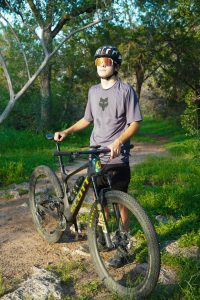
“The program is super accepting and fun, but also serious. I would say that it really pushes athletes who want to excel and take the sport to higher levels, but it’s also accepting for athletes who want to compete for the community aspect of the sport,” Price said. “Roman’s dedication to the sport has really shone through as the years have gone on. He rides every day and sticks to his training schedule, which is the kind of dedication you need in an endurance sport.”
Preparation for competition builds the mental and physical edge that athletes need to perform. It prevents injury, minimizes anxiety, and boosts confidence in athletes like Bercen. He follows a structured routine prior to state, including eating nutritional foods and utilizing recovery time.
“I prepared for state in two phases, one was pre-season and mid-season, which was building motor endurance, and I did that by eating clean, lifting weights, riding five days a week on a training plan, and trying to get to bed early,” Bercen said. “Phase two started the week before our last regular-season race. The week was all about recovery, keeping the legs spinning, and trying to keep my energy level as high as possible for as long as I could each day leading up to the race, at night it was bands, rollers, thera-gun, and ice, as well as electrolytes to keep my body loose and fresh.”
Athletes rely on physical endurance when competing. Cycling specifically requires high demands of cardiovascular output; however, Walker believes mental strength and enjoyment are the most important factors that contribute to success. As a coach he prioritizes racers well-being and overall passion for the sport, leading to the MTB team being a cohesive program with back to back championship wins.
“With mountain biking you have to keep it fun. At the same time you have to be able and ready to give it your all. In cycling it’s referred to as “suffering.” If you can manage to execute that you will have prepared an athlete for when hard work meets opportunity,” Walker said. “Physically, the effort was as high as ever. But what set this season apart was the mental game. This group didn’t just show up to ride; they showed up to defend a state championship.”
In addition to technical skills, the team teaches bikers how teamwork and discipline can impact performance and growth. In hopes of placing at more comps throughout the rest of the season, Gonzalez focuses on eating more carbs, finding a source of motivation, and maintaining a structured routine.
“My favorite part of the team is the support it brings. It has taught me the importance of consistency and what it means to work for something,” Gonzalez said. “The team teaches us how to balance schoolwork and biking by being organized and disciplined. Having my teammates at races helps motivate me to finish.”