


Runners breathe heavy, struggling to hold their goal pace while pushing themselves to their limits. From cold, early mornings, to months of sore legs and preparation, these athletes have endured, all with the end goal of completing a half marathon. For many Bowie students, their commitment to their training will lead them to the starting line.
The International Austin Half Marathon is a 13.1 mile road race that was held on January 18, and had many Bowie finishers. This specific race is designed for speed, and is known for its downtown course. This year over 6,000 runners participated. Bowie began their half marathon program after a student, in 2020, decided to do a half marathon on his own. After that student came back the next year, faster than he was before, Bowie cross country and track coach Laura Tilson founded the half marathon program.
“I realized that by consistently running, building up endurance and distance, he was able to drop time and show a level of commitment to running,” Tilson said. “After that I thought that if we could get more runners to participate in the half marathon, that everyone would get faster come cross country season.”
This event helped lay the groundwork for what would become a permanent opportunity for distance runners to train through the school. However, for some runners, the environment of race day is worth all of the challenging practices.
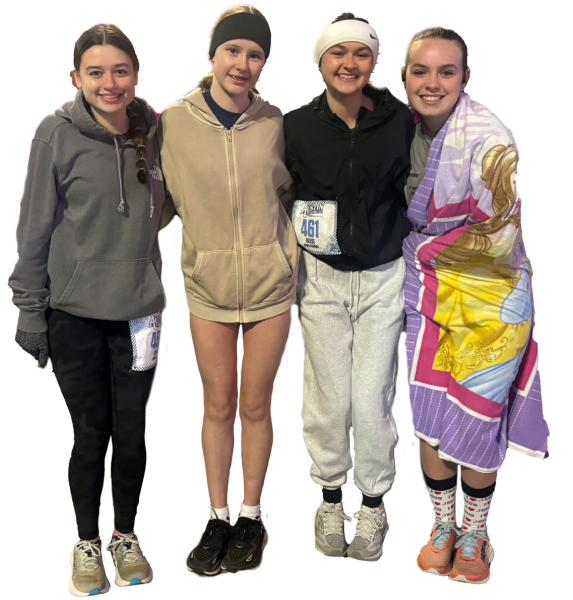
“I ran the half marathon last year and I really enjoyed the race since it was all downhill,” junior Maddie Mahurin said. “It is a really great atmosphere to run in since there is a lot of live music and spectators cheering for us.”
Although everyone has different goals and experiences while running the half marathon, according to Tilson, it is a community. This year, Bowie had 32 students train for the half marathon, providing a diverse community of runners.
“When you start meeting up with people on the daily, you start to meet new people,” Tilson said. “At Bowie, we have a running community, and it’s great to see people branch out from their normal friend groups to connect with new people who share their interests.”
As much as the program unites runners into a single team, runners’ individual motivations change each athlete’s experience throughout the season. For some, it’s the structure of organized training that leads to their commitment.
“It’s nice to be held accountable by someone instead of having to come up with motivation on your own,” junior Blake Martin said. “I was just hoping to accomplish something that feels like I conquered the hill.”
Training for a half marathon involves more than the number of miles each student runs weekly. Coaches watch for attendance, work rate, and general well-being within the entire training program.
“Our goal as a program is to get people to show up, that means consistently coming when they’re supposed to, as opposed to, never being there,” Tilson said. “Even if they are injured or sore, we adjust their amount of running accordingly, we talk individually about how they’re feeling for that day, whether they need to do less running, or more running.”
Beyond excitement for race day, the program also prioritizes balance and injury prevention during half marathon preparation. By prioritizing runners’ health, coach Tilson ensures that students are able to stay healthy while performing at their highest level.
“I liked that we were a community,” Mahurin said. “We all had a shared goal, which got me motivated to actually complete it.”
As half marathon training comes to a close, runners have built up their tolerance of running long distances. However, endurance is not the only factory that benefits students in the long run, but the confidence they have built up during training does.
“I think some of those kids that are doing the half marathon don’t think of themselves as the fastest runners,” Tilson said. “I am proud that they’ve gained confidence from being able to do the distances.”
Leading up to race day, the atmosphere in training starts to shift as runners start to see their progress as they inch closer to their goal of completing the half marathon. During the last few weeks, athletes’ attention has shifted towards their race execution.
“Coach Tilson helped me to be able to do long runs on my own,” Mahurin said. “I wanted to feel more comfortable with 10 mile runs, and she also just helped us to, set goals and know who we should be running with.”
Practices start with groundwork, a five minute jog, and dynamic stretches which according to Tilson, wakes up the muscles. Their workout consists of having a thirty to forty minute run three days a week and one fifty minute long run on the weekend.
“We focus more on the amount of time we spend running than we do distance,” Tilson said. “Most likely it’s more about the fact that you’re on your body or on your feet for a long period of time, less about how fast you’re gonna be going or how many miles you’re doing.”
According to Mahurin, this progressive build up in mileage and consistency has begun to feel real for her. As training demands have increased, mental readiness has become as important as physical endurance.
“I stayed motivated because I knew that I had put in the work that I needed to and I trained hard for a long time,” Martin said. “The last week of training felt rewarding since I knew that I was almost done and I felt ready to compete.”
For Tilson, the goal of the program goes beyond a single race or season. The long term growth of her runners and program is what makes the training worthwhile.
“My favorite part about coaching is building relationships with kids and trying to help them to gain confidence and have fun with what they’re doing,” Tilson said. “I love being able to see them doing things that a lot of them thought they could never do and evolve from not being able to run more than three miles to running a half marathon.”