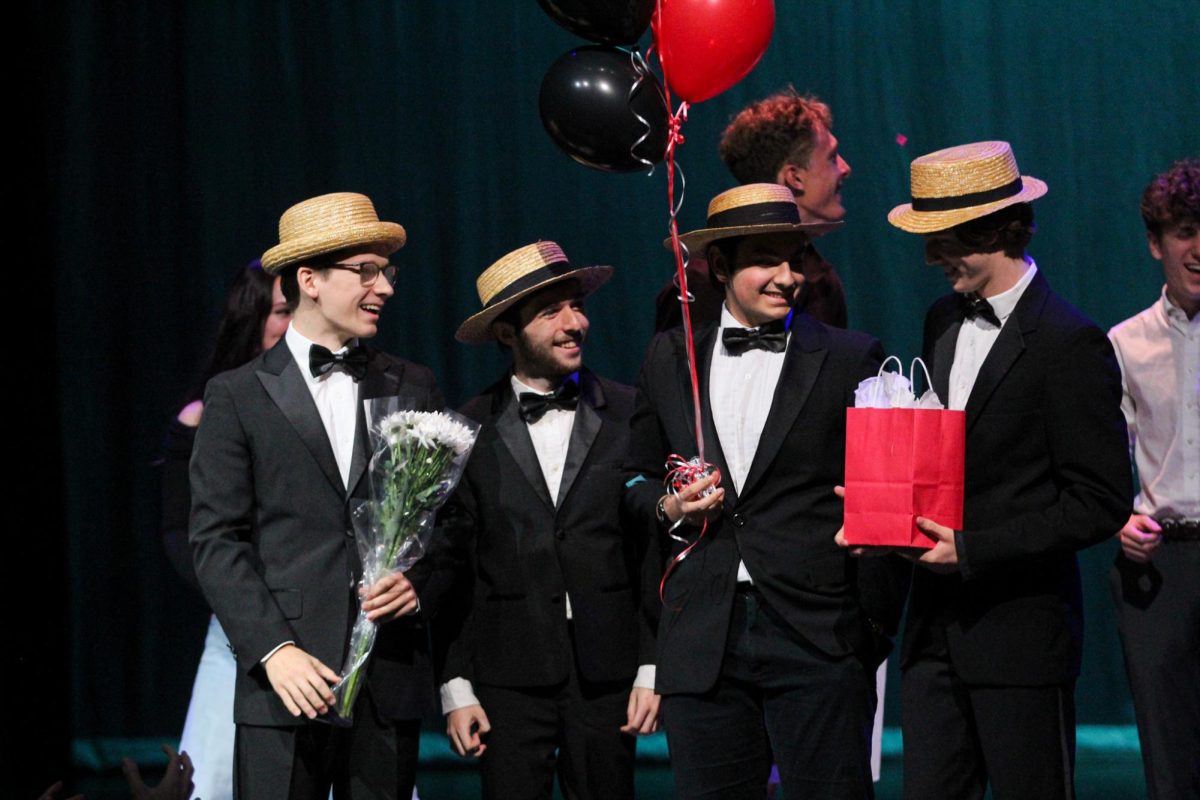


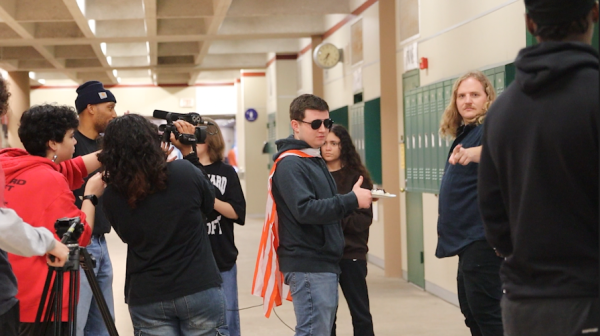
Cameras flash, actors rehearse, and words fly off the page as senior screenwriters Damien Boring and Alex Rodriguez start their production. Their story begins to unfold within a Bowie High classroom.
Inside Creative Writing 1 and 2, students are analyzing literature, learning about character development, and revising plots. According to the Creative Writing teacher Jacob Morgan, any Bowie High School students a part of the program has the ability to submit their own screenwriting for competitions such as the Creative Writing Austin Film Fest.
“Creative writing classes are a fun way to explore modes of writing that aren’t always explored in other classrooms. I am repeatedly blown away by the talent and the things students come up with,” Morgan said. “It always reminds me that there are entire worlds in people’s heads, and we work to bring those worlds out and share them.”
The submission requires students to write between seven and fifteen pages worth of script, including at least two characters, a clear plot structure, and a proper format. After entries are completed, the class reads aloud and votes on the screenplays that demonstrate a compelling, strong structured story.
“The minimum requirement is to have at bare minimum, seven pages, including your title page, because each page, when put into like a full story for a short film, is equated to roughly one minute,” Senior Simone Brock said. “You at least want it to be a certain amount of minutes long to film your overall story. And with that comes like a factor in how much action is going to be involved, what the general dialog is going to be like, and many other things.”
This year, upperclassmen Boring and Rodriguez’s story, Caught in a Bad Spell, was selected as the winner for the Creative Writing Fest, earning the opportunity to be filmed and produced. Senior Alex Rodruigez explains that the story is personally influenced by the many challenges seniors face as they grow up and prepare for major life changes.
“My inspiration for Caught in a Bad Spell was my own personal feelings of being a senior and having to accept that my life is going to change,” Rodriguez said. “I was afraid of losing friends and wanted to make a story that embraced those feelings, but with a happy ending.”
Although Brock’s screenplay, The Night at The Hospital, was not selected, she valued the learning process and feedback from a professional. It gave her insight on her writing style and what her story could improve on.
“And from what I remember hearing my critique, it was something along the lines of them saying, this is a really good story. Has a really good deep overall meaning. It just may have needed some, like, minor grammatical touches,” Brock said. “I think my biggest learning curve was trying to make people speak in a more normal dialect.”
Despite the steep competition, students are encouraged to explore new techniques and be more imaginative. Morgan emphasizes the importance for the class to be creative when brainstorming.
“The main goal of the screenplay unit is to explore a brand new medium. For some, it’s the beginning of a lifelong passion, and for others, it’s just trying new things and giving them some tools to try in other writing,” Morgan said. “A good screenplay should paint a picture of the film that could come from it. Like other genres, it should tell a story in an interesting way, but it should also inspire the filmmakers, actors, and anyone else working on the film.”
Transforming a script into film can be challenging due to different interpretations and limited time. However, Rodriguez admits that working with Boring influenced their story to develop into something deeper.
“The most challenging part was definitely just having to adapt things based on the resources that were available and the time we had. Some things got cut while other things were altered,” Rodriguez said. “Damien and I split the writing based on what we did best mostly. Sometimes we split it by the scene, sometimes by the line. We always heard each other out. He’s a great partner.”
Through writing, filming, and working alongside producers, students participating in the Creative Writing Austin Film Fest, gained knowledge about the career pathway and filmmaking process.
“It was very interesting. I was able to try out many different roles, like cinematographer, that I had never been able to before,” Boring said.“I learned about all of the production it takes to make a film. There’s so many steps involving pre-production, production, and even post-production. It really takes a committed team to make a film.”