

Frankenstein is a novel that has frightened and enthralled its readers for centuries. First published in 1818, the story follows Dr. Victor Frankenstein on his quest and ultimate downfall trying to create life. It is widely considered to be the first science fiction novel, and has inspired countless spin-offs, plays, songs, and legends. But why is Frankenstein so culturally significant? Why is this monster movie still so relevant today? And is it possible to bring such a legendary story to screen?
If you’ve heard about Frankenstein, chances are you’ve also heard that Mary Shelley was only 18 when she wrote it at an informal writing contest. This is both true and misleading. Mary Shelley was 18 when she wrote the first draft of Frankenstein for publication, but the copy we read today went through many edits by Shelley and was republished in 1836. There are a few key differences in the works, but both stand out as well crafted works of fiction.
I read this classic in anticipation for the newly released Frankenstein movie, directed by Guillermo del Toro. I’ve been told numerous times to always read the book before watching the movie, and I wasn’t about to break my streak. However, after finishing Frankenstein, I remember thinking “this should not be a movie.”
The book itself is a masterpiece. It weaves wonder with real-world concerns, and finds itself at the center of conversations now, managing to stay relevant. It’s a fascinating read that I’ve been thinking about since finishing it. Mary Shelley has an incredible way with words. Her writing can transport you to a very different world, one that is complex and difficult to understand.
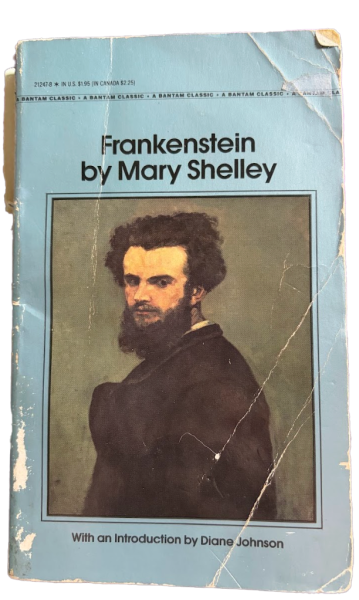
FRANKENSTEIN: A physical copy of
the classic novel, Frankenstein by
Mary Shelly.
Frankenstein is unimaginable. That is what makes it such an iconic story. It exists only in your head, something inconceivable. The monster is rejected because it is out of the ordinary. Reading the book, you want to think that you would be different. That you would accept the monster and be the first one to truly listen. But this is impossible. Through reading not visualizing, you are forced to confront the idea of Frankenstein’s monster, not the image.
Still, I was hearing good things about the adaptation and was, above all, curious. Unfortunately, going to see the movie only confirmed my fears.
I’m not going to say that del Toro’s adaptation was all bad. For one, there were some undoubtedly beautiful shots. You could tell that it was a high budget production when it came to the scenery and landscape shots.
Jacob Elordi was also a standout as the monster. I was skeptical that the former Kissing Booth actor could pull off the role, but he showed a solid complexity that really complemented the character.
Besides Elordi, I thought that the acting in general fell short. Oscar Isaac, who played Victor Frankenstein, had a strange delivery that never quite conveyed enough emotion to be believable.
I’m a big fan of Mia Goth but I thought her performance was also lack-luster. She did what she could with the script, but most of the interactions came across as clunky and unrealistic.
This was one of the biggest failings of the movie, the lack of character development. I understand that a book has more time to spend with the characters, but for a run-time of two-and-a-half hours, there was an unsettling amount of things missing or just not right.
For one, Victor Frankenstein is a very explicitly evil person in the movie. His brother, at one point, even looks at him and says, “Victor, you’re the monster.” This on-the-nose dialogue is common throughout the movie and something that really brought me out of the story.
In the book, there’s a part of you that relates with Victor. He creates the monster in an attempt to make a new discovery and push the limits of science. This makes him naive, but it does not make him evil. You can see yourself in him, which is a part of what makes it so frightening.
The decision to depict him in a completely sinister light really limited the movie. He is shown as a thoroughly corrupt person, blindly driven to create life after the death of his mother at a young age. This explanation did not make sense to me. Although tragic, the death of his parental figure does not explain the bizarre decisions that he makes throughout the rest of the movie. And for such a family-oriented man, we spend almost no time in his childhood or with his family at all.
Then when Victor dies, he randomly becomes sympathetic, calling the monster his son and asking for forgiveness. This made absolutely no sense with his one dimensional character thus far, and was tonally a strange way to end the movie.
There were also a few directorial choices that didn’t make sense to me. Wolves attack houses in packs, we get almost no exposition for the ship scenes, and there is a decision to convey a very close bond that even dips into romance between Elizabeth and the monster.
My last main gripe with the adaptation was the decision to make the monster a supernatural, rapidly-healing creature. This choice was in contrast to the book, with the monster suddenly capable of healing from multiple gunshot wounds overnight and pushing an entire cargo ship out into the ocean.
It’s not as if I have an issue with the unrealistic aspect of this power. My concern is with how this choice turns the creature into a super-villain. It paints him as something completely surrealist and fictionalized. At the end of the day, Frankenstein is man-made. Victor did not find the cure to live forever, he created something life out of death. This bizarre and unexplained decision to give the creature this healing was not necessary in my opinion.
Overall, I have no major gripe with the movie. If you enjoyed it, it’s understandable. I just loved the book and del Toro’s take didn’t add anything new for me to think about.