
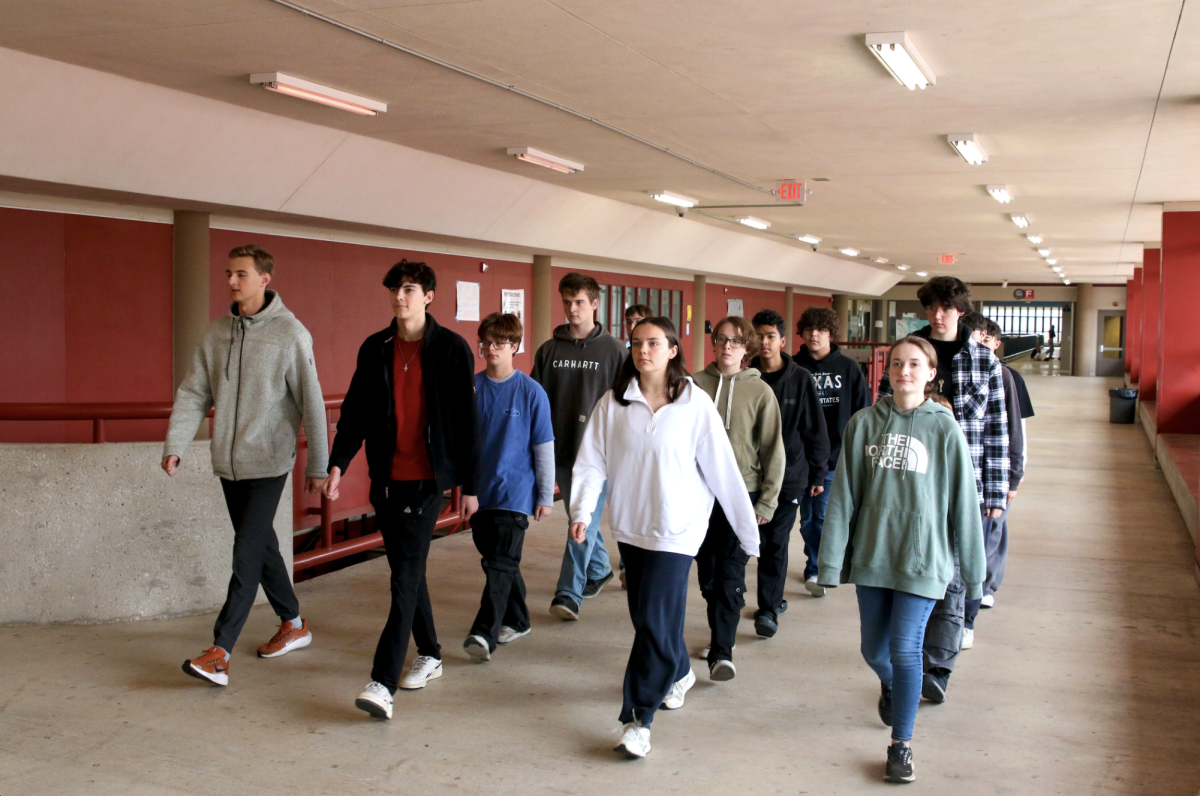
Cadets march and whistles blow as junior Eli Printz steps forward to lead his flight. With a uniform on and a perfect posture, he calls out commands that echo across the courtyard. Trusting his technique, he goes through each movement with precision and confidence.
Printz, now a Cadet Major, has been a part of Bowie High School’s Junior Reserve Officer Training Corps(JROTC) program for three years. He serves as flight commander and is responsible for teaching a small group of student Air Force personnel otherwise known as cadets. What began as a simple elective choice quickly shifted into something more meaningful as he developed new skills.
“I came to Bowie in eighth grade for ‘Dawg day and after seeing JROTC’s recruitment stand I decided to put it on my choice sheet,” Printz said. “I would say JROTC is a great opportunity to get some leadership and teamwork expertise because you’re immediately made responsible for maintaining and wearing your uniform on day one.”
JROTC is a course dedicated to helping students become responsible leaders who focus on serving their community. According to the U.S. Army Junior ROTC website, the program started in 1916 and was established as a way to educate, motivate, and empower young people.
“It’s a really great program; it builds people’s character,” sophomore Rhyland Rigg said. “Despite common belief, it’s not the military; it’s more about learning discipline and respect.”
Lessons range from aerospace science to principles about civics. Despite the variety of topics, Printz often emphasizes the student-led format and learning the structured curriculum.

“We start the class with the pledge of allegiance and then our flight commander will take attendance since it’s mostly a student-led program,” Printz said. “We have two instructors where one of them teaches us about air space topics like science of flight or astronomy and the other teaches us things like civics, the U.S. government, and how to keep track of money.”
According to Chief Lauren Owens, one of the longest tenured instructor at Bowie. JROTC is more than just a class; it’s a place where students like Printz learn qualities like teamwork and responsibility in hopes of preparing them for future challenges.
“It’s an academic class that teaches students the tools they will need to navigate their life after Bowie High School,” Owens said. “They go from being shy and non-assertive to doing briefings and holding leadership positions in JROTC and at Bowie.”
Through experiences like morning formations, marching drills, and boot camps, Printz has grown to be a mentor. As Deputy Commander of Operations, he oversees all functions, organizes events, and guides younger cadets to ensure everything runs smoothly.
“He’s a strong-minded leader who’s open to others’ opinions, and just a great overall person,” freshman Brenn Williams said. “He was super helpful when he took charge and showed me the ropes at boot camp.”
Rigg explains that a Cadet Major’s role extends beyond just following procedures. They set the tone for the program, teach valuable lessons, and serve as a role model for other cadets.
“He was my flight commander last year, where he really got me into the program, and he’s taught me everything I know,” Rigg said. “He definitely can take charge in teams and makes things fun, but when it comes down to it, he gets work done.”
In addition to mentoring, Printz stated he focuses on motivating others, solving issues, and challenging himself outside of his comfort zone.
“He is a mentor to our younger cadets, and gives honest feedback to help others reach their goals,” Owens said. “ We often use the phrase, ‘lead from the front.’ Eli has done exactly that. When issues arise, he tackles them head-on and solves the issue before it becomes a larger issue that affects other students.”
As Printz looks ahead for his final year in the program, he hopes to continue leading and making meaningful changes.
“I kept myself responsible and made sure I was helping everyone out and staying reliable,” Printz said. “I saw some things that could be improved in the way we introduce our program to first years and helped my instructors set goals to change them.”