

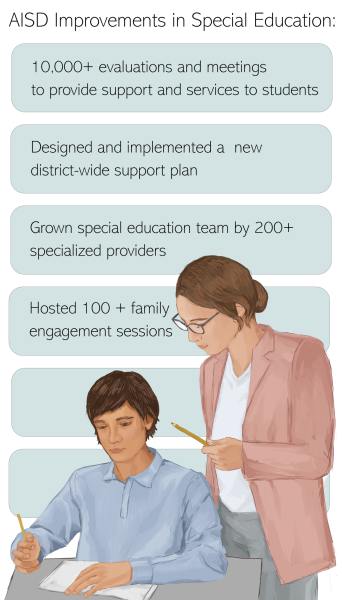
Source: AISD website (Sara Fowler)
After being under state oversight for nearly three years, AISD was officially released from the Texas Education Agency (TEA) on February 17, AISD was placed under TEA supervision after a 2023 state investigation found that there were systematic failures in how the district worked with students who have disabilities. In order to be released from state oversight, AISD had to agree to several requirements that were negotiated with the TEA, and once those were met, the district was able to return to its own control.
As stated in an article from CBS, many parents, teachers, and education advocates urged the district to decline this agreement at the time. They felt that this deal would decrease the control AISD had over Special Education operations. By agreeing to these terms, AISD waived its right to legally challenge the state if it violates any of these requirements.
“There was a lot of backlogs,” special education teacher Alysse Cupelli said. “There’s a process for students to get evaluated and to see if they qualify for special education services. From my understanding, thousands of students were not getting the services they needed, so the TEA decided to take over and review all of our paperwork and the whole evaluation process.”
According to CBS, AISD agreed to several major changes to comply with TEA requirements. One of the things that changed was the required number of minutes spent discussing “student outcomes” and special education monitoring from every meeting to a three-month rolling time frame, which was said to have given the district more flexibility to handle other issues. Additionally, in this agreement, the TEA appointed a team of monitors who are there to help ensure that AISD were properly supporting students with disabilities.
“It’s important for kids to be evaluated quickly so they can get the support they need,” sophomore Eliana Jones said. “When they have the support they need, they can have the most comfortable experience at school without feeling like they’re different from other kids.”
AISD has stated that being released from state oversight isn’t just about compliance, it’s about transforming the special education experience for students. As a part of this transformation, AISD completed over 10,000 evaluations to ensure that every student received support without delay. In comparison, when the district was first taken over, some families had to wait as long as nine months for their students to be evaluated, and more than 600 special education evaluations were considered “out of timeline.”
“We’re definitely sticking to our deadlines now,” Cupelli said. “Usually by high school, most kids have been evaluated and have already started receiving services. We’ve been strict about when we review those evaluations, which is about every three years. We’ve also done a lot of evaluation, ARD meetings, and re-evaluations to make sure everything is up to date.”
According to AISD, they have grown the special education team by more than 250 specialized providers and evaluators. Staff members have also attended 120,000 hours of professional development to help them establish shared practices and high expectations.
“It was my first year teaching when the takeover started, and admin told me that we were going through a lot of changes,” Cupelli said. “Ever since I’ve started teaching here, it’s been about compliance, paperwork, and making sure we are following the processes legally. We’ve had a lot of meetings, trainings, and done a couple of different programs for special education.”
In an update released by AISD, the goal of all of the training is to ensure that students with disabilities are performing at the highest levels. For instance, 3rd-grade Reading STAAR results for students with disabilities in the 2024-25 school year outperformed the state average by 3% points. Similarly, data from second-grade reading and numeracy skills showed a double-digit drop in the percentage of students with disabilities who needed academic interventions.
“If we’re not evolving our efforts to create a better learning environment, then something has to be addressed,” senior Joaquin Flores said. “You don’t realize how important special education programs are until you’ve been involved in them. Once you take a look inside that community, you get to see how important everybody is.”
Conversely, just as AISD is emerging from a state takeover, a new takeover may be pending. According to an article from the Austin Current, AISD is preparing to hand over three middle schools to external partners to avoid another takeover. The district has already been through a charter school partnership with Mendez Middle School, which has been under charter school leadership since 2018 and will return to AISD control this summer after earning a B rating from the state.
“I’d rather the district be in charge of a school because they know Austin better and understand the structure of the school,” senior Gina Linsalata said. “If a school isn’t struggling, then the district shouldn’t bring someone else in, because bringing in some random organization can cause the school to change a lot, harming the students involved.”
Back in 2017, a state law was passed that allowed school districts to enter partnerships with other organizations in order to improve failing schools. In 2018, Mendez entered its first partnership with Texas Science, Technology, Engineering, and Mathematics Initiative (T-STEM), however, it was terminated by the school board in 2021 after the school failed to get passing scores. Mendez then worked with Third Future Schools in 2022 and was able to achieve a passing score for the 2024-25 year, which led the district to announce shortly after that the end of that partnership and the return of Mendez to AISD’s oversight in August of this year.
“If students aren’t improving, then they aren’t going to be prepared for professional settings,” Linsalata said. “Schools should prioritize helping students improve so that the kids can be successful in their future. While bringing in a different organization could cause a lot of disruption for students, it will ultimately benefit them by setting them up for success.”
According to the Austin Current, in a school partnership, accountability consequences such as state interventions for low-performing schools are paused for two years while the charter works to improve the school’s academic performance. The state will also provide additional funding during that partnership, with the extra funding ending when the school is returned to district control. During a partnership, the charter school can alter the curriculum, instructional strategies, programs, staff, and budget decisions, depending on the contract between the district and the charter school.
“I hope that regardless of what’s going on in the district, supporting the students and families involved remains a priority,” Flores said. “Certain aspects of school get overlooked when the district is dealing with other issues, and I think that the district should do their best to be responsible with their time and resources.”