



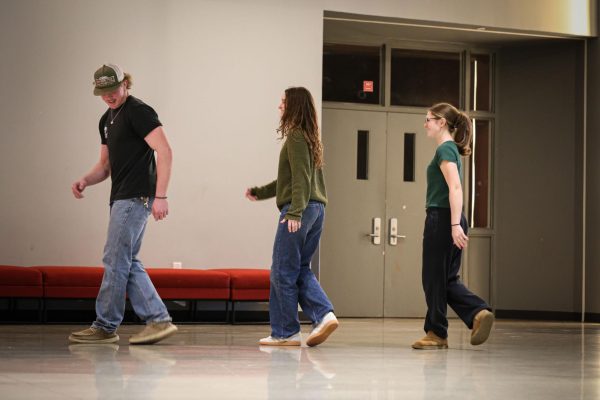
Walking into the dance gym during FIT, senior and co-vice president of Country Kickers, Angelina Prieto, puts her bag down and stands at the front of the room. With the music playing, Prieto lets go of her worries as she practices line dances with her friends. Prieto views this activity as an escape from the real world during school; however, with AISD’s revised Board Policy FNAB, non-curriculum-based clubs, such as this one, will no longer be able to meet during the school day.
FNAB is an AISD Board Policy that created guidelines regarding the use of school facilities for non-academic purposes. According to AISD, it was initially created to comply with the Equal Access Act of 1984 and has now been updated to be in compliance with Senate Bill 12 (SB 12). The revised FNAB went into effect at Bowie on December 5.
“We’ve been over this new policy with our entire staff,” Facilitator of School Improvement Halle Whittington said. “Senate Bill 12 has to do with various things, including student clubs, and that specific part of the law is what led AISD to revise how clubs operate moving forward.”
SB 12 took effect back in September of this school year and included things such as prohibiting school districts from sponsoring clubs organized around sexual orientation or gender identity. However, according to Texas AFT, SB 12 does allow for single sex clubs to exist with missions that “do not advance a political or social agenda.” According to the Texas Tribune, this portion of the bill has received some push-back, with a lawsuit being filed in September against SB 12, which argued that this bill violated the 1st and 14th Amendments and the Equal Access Act.
“The Equal Access Act is a federal law related to student clubs at the secondary level,” Whittington said. “It says schools must give equal access to all non-curriculum-related school clubs.”
According to Cornell Law School, the Equal Access Act, passed in 1984, states that it’s illegal for secondary schools to deny equal access to any student who wishes to conduct a meeting based on religious, political, philosophical, or any other type of speech. Additionally, the meeting must be student-initiated, and teachers or other school employees cannot lead or “sponsor” the meeting. The Equal Access Act also says that these student-initiated meetings can’t interfere with educational activities during the school day.
“It’s important to have non-academic clubs because that’s how a lot of people meet their friends,” Prieto said. “I’m in a few other clubs that are not academic related, and I really enjoy them, so I don’t understand why we can’t meet during the school day.
A student group is considered a curriculum-related club if the subject matter is taught in a regularly offered course, related to a course as a whole, or participation in this club is required for a class. Some examples of this are the Student Council, the National Honor Society (NHS), and the debate club. In contrast, non-curriculum clubs’ content does not align with any classes at a school, with some examples being the anime club, Fellowship of Christian Athletes (FCA), and film club.
“School is a great place where students can join whatever club they want to be in,” senior Navika Amar said. “This new policy is preventing students from doing that because some people have activities before and after school that might stop them from joining clubs.”
In compliance with both the Equal Access Act and SB 12, FNAB says that secondary schools must offer an opportunity for non-curriculum-related clubs to meet on school property during non-instructional time. Before school, after school, and during lunch are times that are considered non-instructional time. Flexible Instructional Time (FIT) is considered instructional time, so non-curricular clubs can no longer meet during this time.
“I think this policy was created so that students could focus on school more and have grades be higher.” Prieto said. “However, non-academic clubs are where people can build a nice community and it’s something that helps keep me mentally okay.”
According to AISD’s Board Policy, the district cannot sponsor any non-curricular student clubs however, a principal may assign a staff member to the club as a monitor to ensure student safety and order without participating in or promoting the club. For curriculum-related clubs, teachers whose curriculum aligns with the club can be considered a sponsor and continue advising as usual. Additionally, this policy prohibits individuals outside of the district from attending or directing student group activities.
“We have a list on the Bowie website that has all of the curriculum-related clubs with the sponsor names, and then we have a list of all the non-curriculum clubs on a different tab with the monitor names,” Whittington said. “Next year, there’s going to be a different application process for clubs. Every single club has to reapply, and the club itself has to be approved by the principal.”
This application process will begin in the 2025-26 school year and continue every school year after that. According to Whittington, curriculum-related and non-curriculum-related clubs will have different application processes. Curriculum-related clubs must complete an application, while non-curriculum-related clubs are required to notify the campus that they will be meeting on campus.
“Fun non-academic clubs are going to face membership shortages, causing them to disband if no one can come to meetings after school,” Amar said. “It’s also going to be harder for clubs to get more members because of these restrictions, and I think this policy is not fair because all clubs deserve the opportunity to meet during school.”